Mean and variance of a beta random variable
Chapter 3 notes. The beta density, for \(0 < r < 1\) and \(\alpha,\beta>0\):
\[p(r) = \frac{\Gamma(\alpha+\beta)}{\Gamma(\alpha)\Gamma(\beta)}\; r^{\alpha-1}(1-r)^{\beta-1}.\]Two tools
- The gamma recursion \(\Gamma(n+1) = n\,\Gamma(n)\). Note that \(\Gamma(n+1)\) is \(n\) times \(\Gamma(n)\), not \(n+1\).
- The normalising identity, which says the density integrates to 1:
For general exponents this integral has no simple antiderivative to evaluate between 0 and 1. The way to use the identity is to recognise the integrand as the right form and match \(a\) and \(b\).
Derivation
Start from the definition of the expected value:
\[\mathbb{E}[r] = \int_0^1 r\, p(r)\, dr = \frac{\Gamma(\alpha+\beta)}{\Gamma(\alpha)\Gamma(\beta)} \int_0^1 r^{\alpha}(1-r)^{\beta-1}\, dr .\]The constant leaves the integral. The extra factor \(r\) merges with \(r^{\alpha-1}\) to give \(r^{\alpha}\). Matching \(r^{\alpha} = r^{a-1}\) gives \(a = \alpha+1\), and \(b=\beta\) is unchanged. The identity gives the integral as \(\Gamma(\alpha+1)\Gamma(\beta)/\Gamma(\alpha+\beta+1)\):
\[\mathbb{E}[r] = \frac{\Gamma(\alpha+\beta)}{\Gamma(\alpha)\Gamma(\beta)}\cdot\frac{\Gamma(\alpha+1)\,\Gamma(\beta)}{\Gamma(\alpha+\beta+1)} .\]Apply the recursion to the two “+1” gamma functions, once each:
\[\Gamma(\alpha+1) = \alpha\,\Gamma(\alpha), \qquad \Gamma(\alpha+\beta+1) = (\alpha+\beta)\,\Gamma(\alpha+\beta).\]Substituting, the gamma functions \(\Gamma(\alpha)\), \(\Gamma(\beta)\) and \(\Gamma(\alpha+\beta)\) cancel between top and bottom and leave only the extra factors:
\[\boxed{\;\mathbb{E}[r] = \frac{\alpha}{\alpha+\beta}\;}\]A common slip is to keep “\(\alpha+1\)” in the answer. The recursion turns \(\Gamma(\alpha+1)\) into the factor \(\alpha\), and \(\Gamma(\alpha+\beta+1)\) into the factor \(\alpha+\beta\).
Special cases
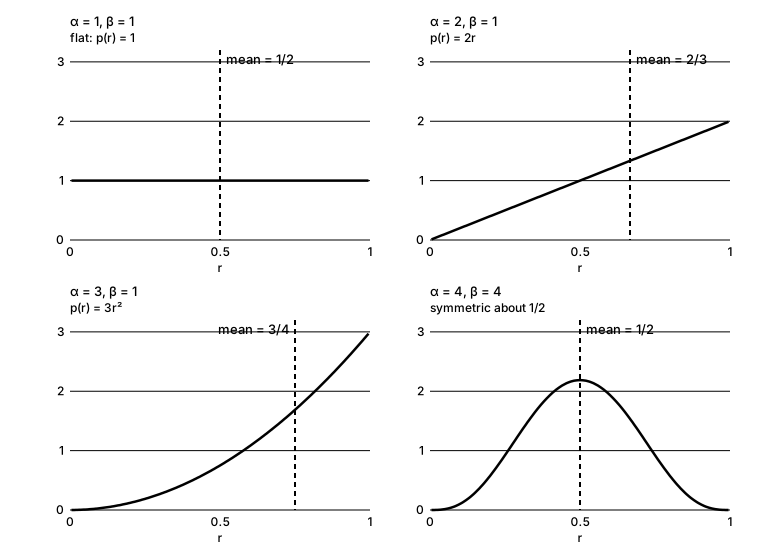
- \(\alpha=\beta=1\) (flat). Every value of \(r\) is equally likely, and the formula gives \(1/2\). Direct check: \(\int_0^1 r\,dr = 1/2\).
- \(\alpha=2,\ \beta=1\) (\(p(r)=2r\)). The density leans to large \(r\). The formula gives \(2/3\). Direct check: \(\int_0^1 r\cdot 2r\,dr = 2/3\).
- \(\alpha=3,\ \beta=1\) (\(p(r)=3r^2\)). Even more weight on large \(r\). The formula gives \(3/4\). Direct check: \(\int_0^1 r\cdot 3r^2\,dr = 3/4\).
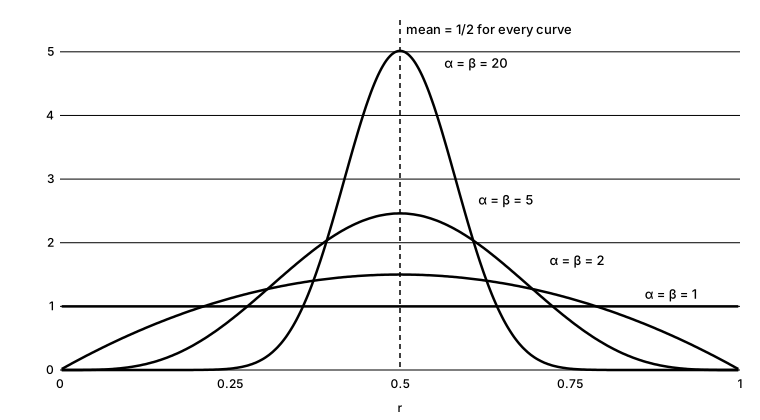
- \(\alpha=\beta\) in general. The density is symmetric about \(1/2\), so the mean is \(1/2\) for every \(\alpha\). Larger \(\alpha=\beta\) narrows the peak but does not move it.
Other sanity checks
- The mean always lies between 0 and 1.
- It rises when \(\alpha\) increases and falls when \(\beta\) increases.
- Pseudo-counts: reading \(\alpha\) as imagined heads and \(\beta\) as imagined tails, the mean is the fraction of the \(\alpha+\beta\) imagined tosses that were heads.
Variance
Use \(\operatorname{var}\{r\} = \mathbb{E}[r^2] - (\mathbb{E}[r])^2\). The mean is done, so only \(\mathbb{E}[r^2]\) is new.
Finding \(\mathbb{E}[r^2]\). The same steps as for the mean, with one more power of \(r\):
\[\mathbb{E}[r^2] = \frac{\Gamma(\alpha+\beta)}{\Gamma(\alpha)\Gamma(\beta)} \int_0^1 r^{\alpha+1}(1-r)^{\beta-1}\,dr .\]Matching \(r^{\alpha+1}=r^{a-1}\) gives \(a=\alpha+2\), with \(b=\beta\). The identity gives the integral as \(\Gamma(\alpha+2)\Gamma(\beta)/\Gamma(\alpha+\beta+2)\). The gamma arguments are now shifted by 2, so the recursion is applied twice to each:
\[\Gamma(\alpha+2) = (\alpha+1)\,\alpha\,\Gamma(\alpha), \qquad \Gamma(\alpha+\beta+2) = (\alpha+\beta+1)(\alpha+\beta)\,\Gamma(\alpha+\beta).\]The remaining gamma functions cancel, leaving
\[\mathbb{E}[r^2] = \frac{\alpha(\alpha+1)}{(\alpha+\beta)(\alpha+\beta+1)} .\]Subtracting the squared mean.
\[\operatorname{var}\{r\} = \frac{\alpha(\alpha+1)}{(\alpha+\beta)(\alpha+\beta+1)} - \frac{\alpha^2}{(\alpha+\beta)^2}.\]Put both fractions over \((\alpha+\beta)^2(\alpha+\beta+1)\). The numerator is
\[\alpha(\alpha+1)(\alpha+\beta) - \alpha^2(\alpha+\beta+1) = (\alpha^3+\alpha^2\beta+\alpha^2+\alpha\beta) - (\alpha^3+\alpha^2\beta+\alpha^2) = \alpha\beta,\]so
\[\boxed{\;\operatorname{var}\{r\} = \frac{\alpha\beta}{(\alpha+\beta)^2(\alpha+\beta+1)}\;}\]Checks and special cases
- Uniform (\(\alpha=\beta=1\)). The formula gives \(1/12\). The beta density with these parameters is the uniform density on \([0,1]\), with \(\mathbb{E}[r]=1/2\) and \(\mathbb{E}[r^2]=\int_0^1 r^2\,dr = 1/3\), so the variance is \(1/3-1/4=1/12\).
- Symmetric in \(\alpha\) and \(\beta\). Swapping heads and tails should not change the spread, and it does not.
- Equal parameters. With \(\beta=\alpha\) it reduces to \(1/[4(2\alpha+1)]\), a function of \(\alpha\) alone. The two parameters collapse to one because the density is symmetric about \(1/2\): the mean is fixed, and \(\alpha=\beta\) only controls how concentrated the peak is.
- More imagined tosses, less spread. The denominator grows like \((\alpha+\beta)^3\) and the numerator at most like \((\alpha+\beta)^2\), so the variance falls as \(\alpha+\beta\) grows. A strong prior is a narrow density.
- Positive for all \(\alpha,\beta>0\).