Posterior for the coin with a flat prior
Chapter 3 notes. Task: the prior over the head probability \(r\) is flat, \(p(r)=1\) for \(0<r<1\). Find the posterior \(p(r\mid y)\) after observing \(y\) heads in \(N\) tosses.
Bayes’ rule up to a constant
\[p(r\mid y) = \frac{p(y\mid r)\,p(r)}{p(y)} \;\propto\; p(y\mid r)\,p(r).\]The denominator \(p(y)=\int p(y\mid r)p(r)\,dr\) has \(r\) integrated out, so it does not depend on \(r\). As a function of \(r\), the posterior has the shape of likelihood times prior, and the constant can be recovered at the end.
The two factors
- Prior. \(p(r)=1\). Multiplying by it changes nothing.
- Binomial likelihood. The binomial formula, with the observed \(y\) and \(N\) held fixed and read as a function of \(r\):
As a probability, this formula is a distribution over the count \(y\) for a known \(r\). As a likelihood, it asks how well each possible \(r\) explains the data you saw. It is not a density over \(r\) and does not integrate to 1.
Rearranging
Drop everything that does not contain \(r\). The binomial coefficient \(\binom{N}{y}\) goes into the constant:
\[p(r\mid y) \;\propto\; r^{y}(1-r)^{N-y}.\]A beta density is proportional to \(r^{a-1}(1-r)^{b-1}\). Matching exponents:
\[a-1 = y \;\Rightarrow\; a = y+1, \qquad b-1 = N-y \;\Rightarrow\; b = N-y+1.\]The shape is that of a beta density, so the normalising constant must be the beta one, \(\Gamma(a+b)/(\Gamma(a)\Gamma(b))\) with \(a+b=N+2\). There is no need to compute \(p(y)\):
\[\boxed{\;p(r\mid y) = \frac{\Gamma(N+2)}{\Gamma(y+1)\,\Gamma(N-y+1)}\; r^{y}(1-r)^{N-y}\;}\]This is a \(\mathrm{Beta}(y+1,\;N-y+1)\) density.
Checks
- General conjugacy. The beta prior \(\mathrm{Beta}(\alpha,\beta)\) with a binomial likelihood gives \(\mathrm{Beta}(\alpha+y,\;\beta+N-y)\). With \(\alpha=\beta=1\) this is the result above.
- No data (\(N=0\), \(y=0\)). Both exponents are 0 and the constant is \(\Gamma(2)/(\Gamma(1)\Gamma(1))=1\), so the posterior is flat, the same as the prior.
- All heads (\(y=N\)). The density is proportional to \(r^N\), which leans toward \(r=1\).
- Pseudo-counts. The flat prior counts as one imagined head and one imagined tail. The posterior parameters are the observed counts plus one each.
Picture
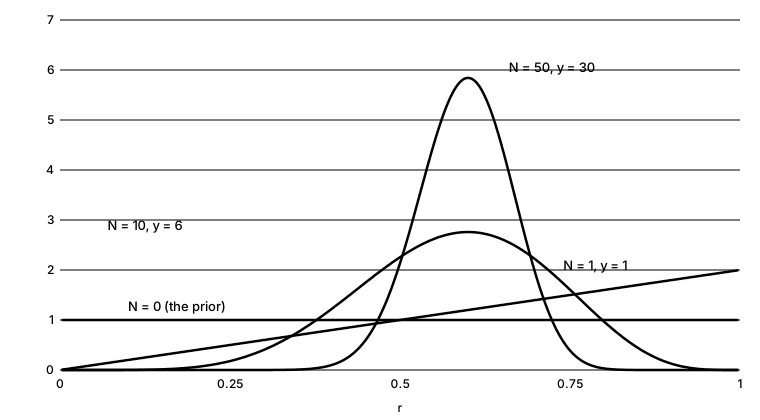
The flat line is the prior. One head tilts the density toward large \(r\) but leaves it wide. With more tosses the density narrows around the observed fraction of heads. The more data, the less the flat prior matters.