Distance, divergence, discrepancy and metric
In one paragraph
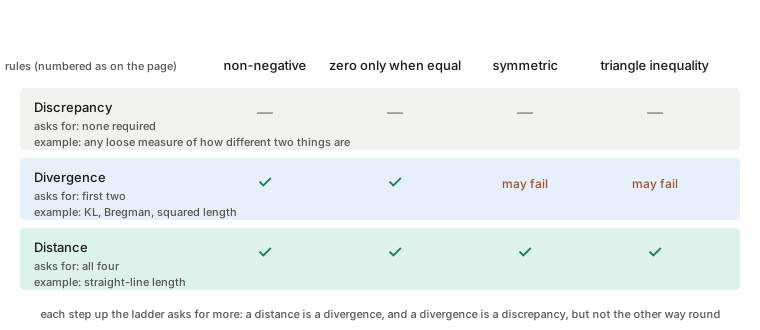
Distance, divergence, metric and discrepancy all talk about how far apart two things are, and they differ in which everyday rules of distance they keep. A discrepancy is the loosest word and asks for none of them. A divergence keeps only the first two, so it may be lopsided. A distance keeps all four. A Riemannian metric is something else: a ruler for tiny steps at one point of a curved space, which yields distances by adding up the steps. Information geometry starts from a divergence and reads a metric off its bottom.
The picture
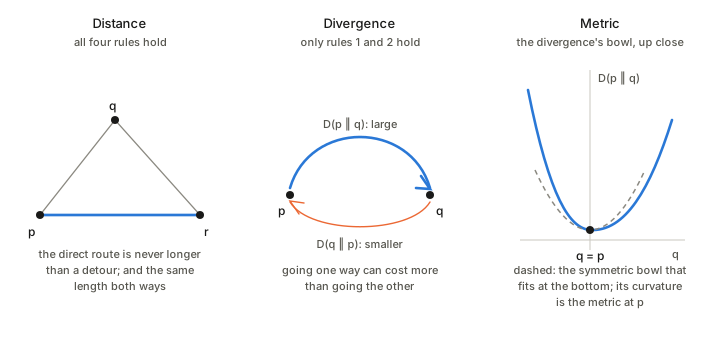
Distance
A distance d(p,q) gives a number to every pair of points and obeys four rules:
- Non-negative: d(p,q) \ge 0.
- Zero only for identical points: d(p,q)=0 exactly when p=q.
- Symmetric: d(p,q)=d(q,p). The trip there is as long as the trip back.
- Triangle inequality: d(p,r)\le d(p,q)+d(q,r). A detour never shortens a trip.
Straight-line distance on a map obeys all four. (Analysts call a function with these four rules a “metric”, which is not the Riemannian metric below; that is the main source of confusion.)
Divergence
A divergence D(p\,\|\,q) keeps rules 1 and 2 and drops the other two. It says how different q is from p, but it may differ from D(q\,\|\,p) and it need not obey the triangle inequality.
The standard example is the Kullback–Leibler divergence between two probability distributions. Think of forecasting: predicting rain on a day that stays dry costs something different from predicting dry weather on a day that rains, so asking “how bad is q as a stand-in for p” is a one-way question. A divergence still behaves like a squared distance near its minimum: zero at q=p and rising like a bowl around it, which is the positive definite picture of the previous foundations page.
Discrepancy
Discrepancy is the loosest of these words: any number that says how different two things are, with no rule required. It need not be non-negative, need not be zero when the two things agree, and need not be symmetric. Texts use the word differently, so read it as the umbrella term. A divergence is a discrepancy that obeys the first two rules, and a distance is one that obeys all four.
An example that is a discrepancy but not a divergence: cross-entropy. The cross-entropy -\sum_xp(x)\log q(x) between two distributions measures how costly it is to describe data from p with a code built for q. It is a perfectly good discrepancy, but it is not zero even when q=p: in that case it equals the entropy of p, which is positive. What is missing is a baseline. Subtract that baseline (the entropy of p) and what is left is the KL divergence, which is non-negative and zero only when q=p. This is why the machine-learning loss (cross-entropy) and the KL divergence differ only by a constant that does not depend on the model.
Why the loose word is useful. Many things used to compare a model with data are discrepancies without being divergences: a squared error loss, a cross-entropy, a negative log-likelihood. The step from discrepancy to divergence, which is the step this page’s earlier figures build on, is checking that the quantity is non-negative and zero only at equality. That is what makes it possible to read a metric off its bottom.
Riemannian metric
A Riemannian metric is a ruler attached to every point of a curved space. At each point p it is a positive definite matrix g(p), and it measures a tiny step dx as dx^\top g(p)\,dx. Adding up these tiny lengths along a path gives the path’s length, and the shortest path is a geodesic; its length is the distance between the endpoints. So a metric is a local ruler that produces a global distance.
How they connect
- A distance works between any two points, near or far.
- A metric tensor works only for tiny steps at a point; distances are built from it by adding up steps along paths.
- A divergence is a one-way, possibly lopsided measure. For two nearby points its leading behaviour is a squared length, and that squared length defines a metric: D(p\,\|\,p+dp) is, to leading order, half of dp^\top g(p)\,dp. In the figure this is the dashed bowl fitted at the bottom of the lopsided one.
That last link is the opening idea of Amari’s book: the KL divergence between nearby distributions produces the Fisher information matrix as its metric. What the divergence carries beyond the metric, namely its lopsidedness, is the extra structure of the dual connections. Chapter 1 begins from divergences: Chapter 1: dually flat structure.
- Derivatives: the metric of a potential is its Hessian, and coordinate changes use the Jacobian: Jacobian and Hessian.
Takeaways
- A discrepancy is any measure of how different two things are, with no rule required; divergence and distance are special cases.
- A distance obeys four rules: non-negative, zero only for identical points, symmetric, and the triangle inequality.
- A divergence keeps the first two only, so it may be lopsided; KL is the main example.
- A Riemannian metric is a positive definite matrix at each point that measures tiny steps; distances come from adding steps along a path.
- Near its minimum a divergence is a squared length, and the matrix of that squared length is the metric.