What a measure is
In one paragraph
A measure is a rule that gives a size to sets of a space: length, area, mass, or probability. It takes a set A and returns a number \mu(A)\ge 0, and it obeys one sanity rule: if you glue together pieces that do not overlap, their sizes add. A probability measure is the case where the whole space has size 1, and P(A) is the chance of the event A.
The picture
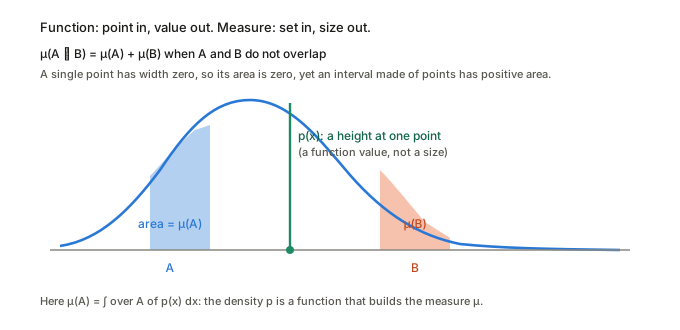
The definition, piece by piece
A measure \mu is defined on a space X together with a collection \mathcal A of subsets, the measurable sets. It must satisfy:
- Nothing has no size: \mu(\varnothing)=0.
- Additivity: for non-overlapping A_1,A_2,\dots in \mathcal A, \mu\big(\bigcup_i A_i\big)=\sum_i \mu(A_i).
Why only some sets? On the real line one cannot give every subset a consistent length. So you keep a well-behaved collection \mathcal A, called a \sigma-algebra: it contains X, and it is closed under complements and countable unions. Together, (X,\mathcal A,\mu) is a measure space. In practice you rarely meet a non-measurable set.
Common examples
- Length (Lebesgue measure) on the line: the size of [a,b] is b-a.
- Counting measure: the size of A is how many elements it has.
- Dirac measure at x_0: the size is 1 if x_0\in A, else 0. All the mass sits on one point.
- Probability measure: total mass 1. For a continuous variable, a single value has probability 0, while an interval has positive probability.
Measure versus function
A measure is technically a function, but its input is a set, not a point. This is why a probability density p(x) is not itself a probability: it can exceed 1. It is a rate, turned into a size by adding it up over a set,
\mu(A)=\int_A p(x)\,dx .
So a function p can build a measure \mu, and p is then called the density of \mu. Some measures have no density at all: the Dirac measure cannot be written as an ordinary function. This is the reason measures are the more general tool. Going the other way, a measure is what you integrate against: \int f\,d\mu weights the values of f by how much \mu puts on each region, and the expectation E[f] is this for a probability measure.
“Positive” measure
A positive measure has \mu(A)\ge 0 for every A. This is just the ordinary case, named so to set it apart from signed measures (which can be negative) and complex measures. A signed measure splits into a difference of two positive ones, \mu=\mu^+-\mu^-, which is why positive measures are the basic building block.
Why it matters for information geometry
- A point of a statistical manifold is a probability measure (usually given by a density p(x;\theta)). The manifold is a family of them.
- Distances between them, such as the KL divergence, compare two measures. KL needs one to have a density with respect to the other, the Radon–Nikodym derivative dP/dQ, which exists exactly when P\ll Q (absolute continuity: Q(A)=0 forces P(A)=0).
- The distribution of a random variable f(X) is the pushforward of the measure of X through f.
Related ideas to learn next
\sigma-algebra, measurable function, Lebesgue integral, absolute continuity, Radon–Nikodym derivative, pushforward measure, product measure.