What FID sees: position, orientation and clusters
Why this page exists
These notes came out of reading Wu et al., A Pragmatic Note on Evaluating Generative Models with FID for Retinal Image Synthesis (MIDL 2026; see the MIDL 2026 overview). The paper shows that FID does not track how useful synthetic images are for training. To see why that is unsurprising, it helps to know exactly what FID can and cannot see. The answers below are written as the questions came up, with pictures instead of calculations.
The formula, for reference. Fit a Gaussian to the real features (\mu_r,\Sigma_r) and one to the generated features (\mu_g,\Sigma_g), then
\text{FID} \;=\; \underbrace{\lVert \mu_r-\mu_g\rVert^2}_{\text{position}} \;+\; \underbrace{\operatorname{Tr}\!\Big(\Sigma_r+\Sigma_g-2\big(\Sigma_r\Sigma_g\big)^{1/2}\Big)}_{\text{size, shape and orientation}} .
This is the 2-Wasserstein distance between the two fitted Gaussians (see optimal transport, Closed forms worth memorising).
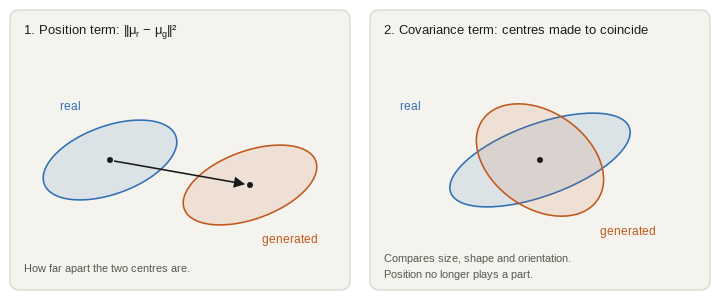
Q1. Does FID require the two feature clouds to have the same mean?
No. It allows different means but charges for them. The first term is the squared distance between the two centres. It is zero only when they coincide, and otherwise it adds to the score directly. It is completely separate from the covariance term: shifting one cloud without changing its shape raises the first term and leaves the second untouched.
Q2. Is FID blind to orientation because of the trace?
No. The trace makes FID ignore a rotation of the whole space, not a rotation of one cloud against the other. Two different things are going on inside the covariance term:
- \operatorname{Tr}(\Sigma_r) and \operatorname{Tr}(\Sigma_g) are each a cloud’s total variance. These two pieces really are indifferent to orientation.
- The cross term \operatorname{Tr}\big((\Sigma_r\Sigma_g)^{1/2}\big) is not. It measures how well the two clouds’ principal axes line up. It is largest when they are aligned and shrinks as they turn apart, and because it is subtracted, misalignment raises FID.
So two clouds with the same shape and size but different orientations get a positive FID. The only shape that looks the same at every orientation is a round one, and only then does turning it change nothing.
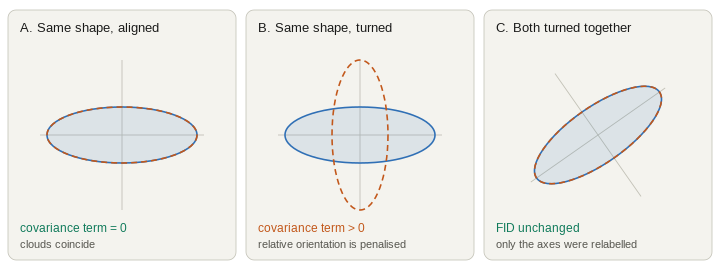
What FID does ignore. Rotating, reflecting or shifting both clouds together. That is the invariance the trace buys: the choice of coordinate axes does not matter, but how the two clouds sit relative to each other does.
Where the “orientation-invariant” intuition comes from. The covariance term is the squared Bures–Wasserstein distance between the two covariance matrices, and one way to write it involves a minimisation over rotations. That looks like “the best rotation is chosen for you”, but it is not a rotation of the cloud. A covariance matrix has many “square-root” factors A with AA^\top=\Sigma, which all describe the same cloud, and the minimisation only picks the most convenient one. No cloud is ever turned. When the two clouds’ axes happen to be aligned, the covariance term reduces to comparing their spreads axis by axis; any misalignment adds to that.
Q3. How does FID treat one Gaussian versus two separate clusters?
It cannot tell them apart, because it only ever sees a mean and a covariance. FID replaces each feature cloud by the single Gaussian with the same mean and covariance. For a cloud made of two separated clusters, that fitted Gaussian is centred in the gap between them and stretched along the line joining them: the covariance adds the spread within each cluster to the spread between the cluster centres. A single blob with that same mean and covariance has the same fitted Gaussian, so FID between the two is zero.
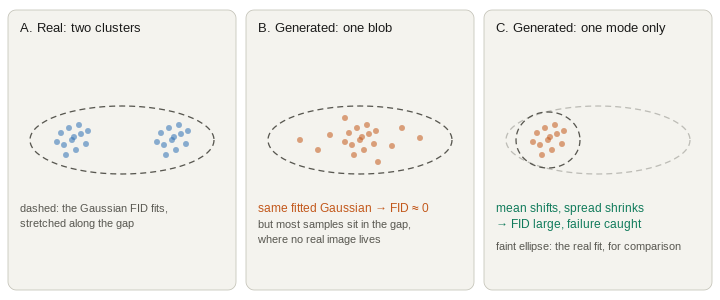
What this means in practice, case by case:
| What the generator does | What FID sees | Caught? |
|---|---|---|
| One blob filling the gap between two real clusters (blurry “in-between” images) | same mean and covariance as the real data | No |
| Collapses onto one of two equal clusters | mean shifts by half the gap, between-cluster spread disappears | Yes |
| Drops a small cluster (a rare class or rare finding) | mean and covariance barely move | Mostly no |
| Right clusters, wrong proportions | mean moves towards the over-represented cluster | Partly |
| Right mean and covariance, wrong shape in other ways (skew, heavy tails, rings) | nothing beyond second moments | No |
The third row is the one that matters most for medical imaging. The rare classes and rare findings are exactly what synthetic data is often meant to supply, and they are what a mean-and-covariance summary weighs least. This is one concrete reason a good FID need not mean useful training data, which is the point of the MIDL paper.
What does see clusters. Metrics that compare whole distributions rather than two moments: KID (a kernel two-sample statistic, which with its polynomial kernel reaches beyond the covariance), precision and recall in feature space, which separate “are the samples realistic” from “is every region of the real data covered”, or simply counting samples per class or per cluster. Changing the feature network (CLIP, DINOv2, a domain model) changes where the clusters lie but not the fact that FID summarises them with one Gaussian.
Questions and doubts
- Real feature distributions in a 2048-dimensional Inception space are clustered by class and content, so the “two clusters” picture is the normal case, not an edge case. How much of FID’s value on a typical dataset comes from the between-cluster spread rather than the realism of individual images?
- The closed form is exact for Gaussians and, as the MIDL authors note in their rebuttal, for the wider family of elliptical distributions. Either way it depends only on the mean and covariance, so the blind spots above remain.
- For a class-conditional generator, computing FID per class would remove the between-class spread and the gap-filling blind spot. How often is that reported?
Takeaways
- The mean term charges for a shift; the means do not have to match, but every bit of distance costs.
- The trace forgives rotating the whole space, not rotating one cloud against the other.
- FID sees each dataset as one Gaussian, so it cannot distinguish one blob from two clusters, and it barely notices a missing rare cluster.